Sunday, 20 September 2026

Waiting For Godot at the Guthrie Theater - A Review

     The thing about theater is there is no denying the necessary social component of it as an art. (I argue this is true of all Art - a very German conception- mostly to no avail, but....) a production of a play has to have not only the script and actors, it also has to have an audience and direction. The production additionally occurs in a specific time and references a different place and/or time. The interaction between actors, playwright, director and audience produces a conversation and the possibility of a meaningful effect on all those involved. For this reason alone I encourage people to go to their local theater and support the arts. As we see a major assault on the arts and theaters occurring right now in the United States, it should be easy enough to understand why. When we share stories (through images, paintings plays, books, ballets, music) we connect and interact with each other. We think about what is important in life, about others, and about their ways of seeing/ hearing/ understanding the world. We become better people. Please support your local arts.

     As a preview subscriber, I get a week to think about the Guthrie's new productions before the official reviews launch. It is a good sign when I find myself still thinking about a production a whole week later and the Guthrie's Godot has given me ample material to consider. I offer some thoughts here for others. I hope readers will do the same.


     Those who have read my reviews know that I am extremely picky and critical, so let me start therefore by saying that this is a very good production that warrants seeing. David Strathairn is excellent (as is expected) and handles the weighty role of Vladimir believably and with apparent ease. This no small feat given he is speaking a good 40% of the time. This is a lot to memorize and render believably, especially when there is no solid chronology of events to help kickstart the memory. Playing a character who is at a loss for meaning and topics of conversation is (in my opinion) akin to the Herculean task of capturing the hind of Menelaus. ( I was going to say 'cleaning the Augean stable' but I guess part of the play's point is that the stable will not or perhaps cannot be cleaned). Strathairn carries the role of "Didi" almost faultlessly and keeps the play moving along in the way that it should. (No, not smoothly; haltingly, but with a modicum of beauty.) Jimmy Kieffer does a nice job with the more yokal Estragon. He has the right amount of naivete, and goofiness, although at times is a bit too self-effacing.  I am also in awe of Jim Lichtscheidl in his physical representation of "Lucky"and his ability to memorize utter nonsense and spew it rapidly without faltering. 

     I think one of the big problems for people staging Godot is that as written, the second act drags. As Vivian Mercer, critic and scholar, noted in The Irish Times in 1956 "..since the second act is a subtly different reprise of the first, [Beckett] has written a play in which nothing happenstwice." This is somewhat untrue, but does speak to the problem of presenting a play whose subject matter is the emptiness and absurdity of human life.

     This, of course, is where the expertise of the director comes in. A good director manipulates  the pace and the message, knowing how to pull an audience just beyond its comfort zone, without completely alienating or estranging it. One may want to point out the utter vacuousness of existence, but one doesn't want mass suicides after the end of the production.

     ...And that being said, Joseph Haj's is one of the least depressing visions of "Godot" that I have ever seen. I confess, I dreaded seeing the play again after so many years, which I remembered as bleak and un compromising, but this time I left the theater in reflection, but not despondent. One of the directorial choices made by Haj to speed up the second act, seems to be the heightening of the comic absurd. He does this by giving free rein to William Sturdivant in his portrayal of the obnoxious, over-privileged character of Pozzo. I sometimes have mixed feelings about Sturdivant's performances, but he has grown by leaps and bounds as an actor over his years on the Guthrie stage and one must always grant that whatever he does, he does with full commitment. Pozzo is so excessive and ludicrous in his self-indulgence, that the audience laughs at him and is pulled through the slower parts of the play. He annoyed me, but also kept me from getting bored. Sturdivant's performances make me think.

     In earlier years, I had understood the relationship of Pozzo and his "menial" Lucky as one that showed the inconstancy of the wheel of fortune. In the first act, Lucky enters with a long rope around his neck carrying the bags of his master Pozzo. Pozzo follows barking authoritarian commands rope in hand. In the second act, Pozzo enters blind, led in by Lucky, but the rope is shorter and the mighty has fallen (literally). To me, it was a question of who was leading, of who had control. This reappearance is apparently only a day later, but when Didi and Gogo ask about how Pozzo became blind and the timeline, Pozzo, (who after all has lost his watch) does not grasp their sense of "time". "One day, is that not enough for you," he cries, "One day he went dumb, one day I went blind,  one day we'll go deaf, one day we were born, one day we shall die, the same day, the same second, is that not enough for you?"  But of course it is not enough for any of us.

      Under Haj's direction the play is less about the fact that any of us could be in the situation of any of the characters and is more about what we choose to do with the time we have here. Pozzo, like other authoritarians abuses those he governs and experiences no compassion when he finds himself blind and in a less privileged position. This is contrasted with the kindness with which Vladimir treats his less mentally capable friend Estragon. He cares for his swollen feet, feeds him, and soothes him when he has nightmares. Perhaps there is a message there about the blindness of the powerful to their own complicity in their downfall, but it doesn't seem to matter to Didi, to Gogo or even to Godot.

     My quibble with the direction of this version of Godot is that by picking up the pace, it also at times, misses the other important answer to the plays' question. No, the question is not what we are waiting for. (We are waiting for Godot.) The question as we see above is "How are we waiting?" One way, is by showing compassion to our friends. Another is art, by interacting with others in words. Didi and Gogo entertain themselves with conversations and acting and even dance. But there is also an overarching theme of how we in the audience are connected by the words of the playwright. There is a lovely, lyrical passage in the play where Didi and Gogo make conversation alternating their descriptions of "All the dead voices. They make a noise like wings. Like leaves. Like Sand. Like leaves, etc." I wish the audience had been given more time to absorb the beauty of this passage as the two characters play with the words. 

     In the same vein, I wish that Vladimir's final speech (before the boy appears at the end) had also had more space and gravity. Although we know not to expect a definitive meaning to the play, it is one of Didi's longest commentaries and it feels important to me. Vladimir says, "Was I sleeping, while the others suffered? Am I sleeping now? Tomorrow, when I wake, or think I do, what shall I say of today? That with Estragon my friend, at this place, until the fall of night, I waited for Godot? That Pozzo passed, with his carrier, and that he spoke to us? Probably. But in all that what truth will there be?..." Vladamir's questions speak to his humanity, which is after all, what this play is about. And they emphasize the importance of questioning itself and of words. We in the audience all know that Godot is unlikely to ever show up for Didi and Gogo, but we also know that the only connection Vladimir may have with the mysterious Godot is the message he gives to the boy. "tell him you saw me."

What can we do for the arts in our world today? There is much forgetting in the play. In fact Didi is desperate at the end for the boy to remember that he has seen him; to know that he exists. Go to the Guthrie and see the play. Then keep the arts alive; tell everyone you saw it. Well,.....What are you waiting for?

Friday, 6 December 2024

Artifacts of my Father's War Experience


 My father, Richard L A Sterba, was a navigator and bombardier on a B-17 during the Second World War. He served with the 301st BG, 353rd Squadron and was stationed in North Africa and later Italy. My dad flew more than 400 missions and only stopped because he got shot down over Yugoslavia and was smuggled to safety by the Yugoslavian underground. The Air Corps' policy was not to send people out again after such an experience in case he should be captured on a future mission and tortured and thus might put those valiant resistors in danger, so they pulled him back to California for the last few months of the war to be an advisor for Hollywood war films. As we age we have to go through our parents' estates, which seem to comprise an awful lot of papers and I wanted to include a couple interesting ones here. 

For example, this is a leaflet in Hungarian asking the people if their consciences are clear. The bombers would drop these to try and encourage resistance against the Nazis.:


Today I happened upon a poem written by my father about what those bomber missions felt like and I wanted to put it out on the web, because it is not only a historic document, but because I am sure it will resonate with others wh have had similar experiences.


Friday, 31 May 2024

A Little Birding during Warbler Season

We have a little birding group that has developed as the warblers have been coming through on their way to Canada.  (Click on the image below to enlarge them and see just the pictures! ;-). )


I have never been particularly good at bird photography because I am unwilling to lug around a tripod, but I still love to post pictures of what I see.  We headed off to a little park along their Mississippi River and were fortunate to see the Cedar Waxwings migrating en masse.


They are lovely birds with the dramatic yellow stripe at their tail bottoms.


I am not sure what some of these birds are, and of course I didn't capture a lot of the ones we saw, but I'll post the ones that might be recognizable.


This is a hairy wood pecker. I know them, because we have them at home!


We watched him looking for dinner.


Here is the intrepid birding team!


Way across the river there was a bald eagle surveying his territory.


I was also fortunate to capture a shot of this yellow-throated warbler.


I have no idea what this one is!


This is not the same bird, but may be the same kind!


This week we went camping at Glacial Lakes Park and got a chance to see a different cast of characters!


We had heard red starts at the on the other trip, but I had been un able to get a picture of any.


We seemed to be camping on this guy's territory so I had many opportunities (but of course I still didn't get a crisp shot!)


There Mississippi is a beautiful river, so no wonder it attracts so much wild life.


Early on our first walk after  setting up our tents we saw this scarlet tanager.


There were also lots of wildflowers in bloom. These white ones are tiny, but so pretty! I guess they are common chickweed (stellaria media).


I don't know what this bird is. Could be a Phoebe or a cat bird, I guess.


I got very excited when I saw this yellow flower, because I thought it was a wallflower, but it turns out it has 5 petals instead of the 4 of the brassica family, so I guess it is an evening primrose.


This region is dominated by gigantic and gorgeous bur oaks. They have fringy acorns, but are best known for the beautiful ridgy patterns in their bark.


Here is a better idea of what the landscape of the area looks like. there are numerous lakes formed by (disappeared) glaciers.


Hunting time!


Somebody found some dinner!


Our campsite was lovely a combination of shade and sun and we were accompanied by the music of the redstarts as we (Not me I was lazy) prepared dinner.


The next morning we had a lovely walk. We used Merlin to identify birds from their song and I was lucky to catch this yellow throat as he took a rest between serenades.


I was overjoyed to capture this little guy - a ruby crowned Kinglet. They are a common bird, but they flit around so furiously that I rarely have a chance to get a good view, let alone a picture of them.


I find the white around the eye quite fetching.


This is a fuzzy shot, but I love the exuberance of it!


I don't have a good view of this songster, but here is another shot.


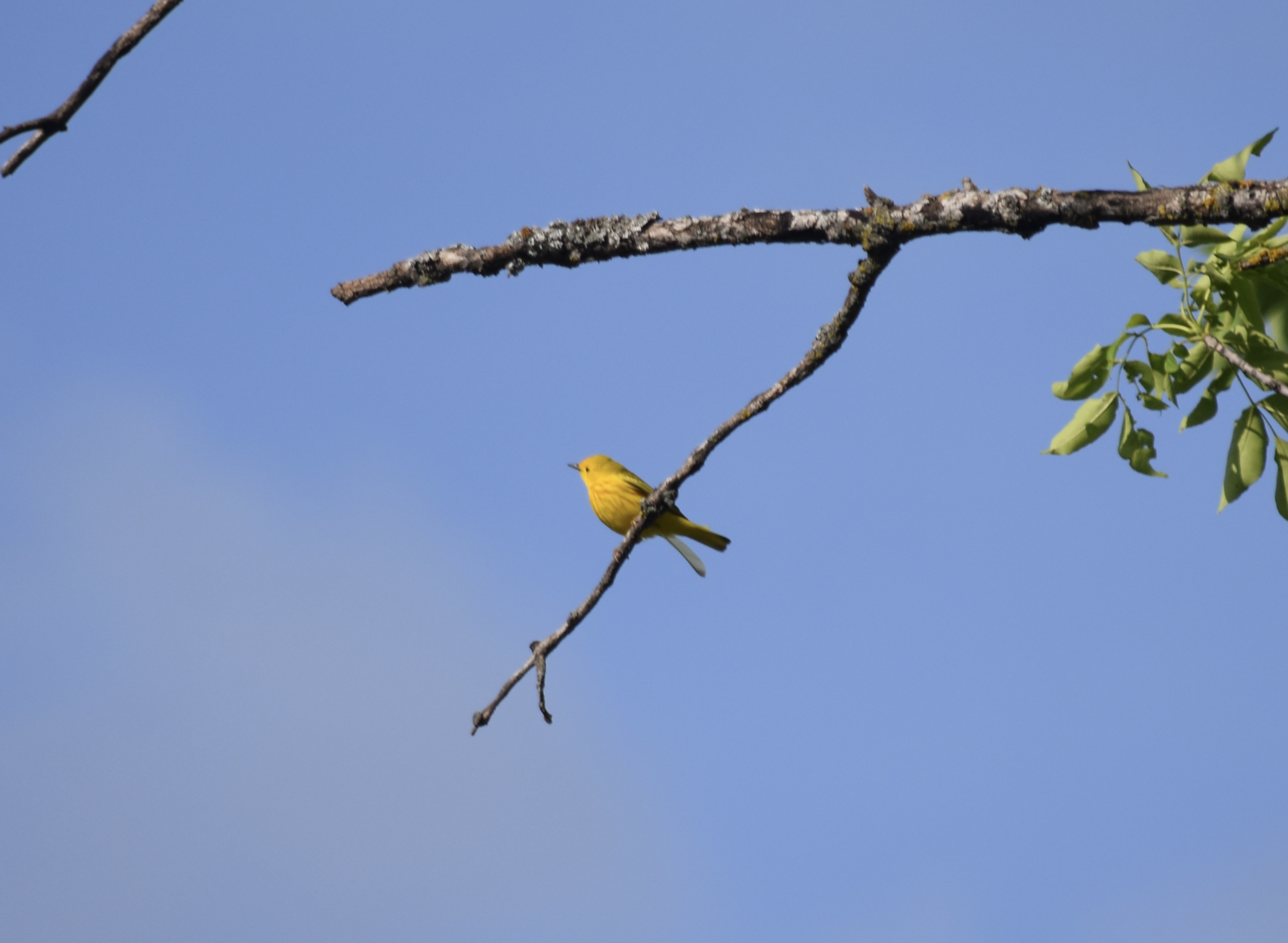
This yellow warbler also sang to us.


It was nice of him to choose bare branches for a rest.


I believe this is probably a thrush, but I never got to see the head.


Here is another little songster, possibly a red poll, but more likely a chipping sparrow!


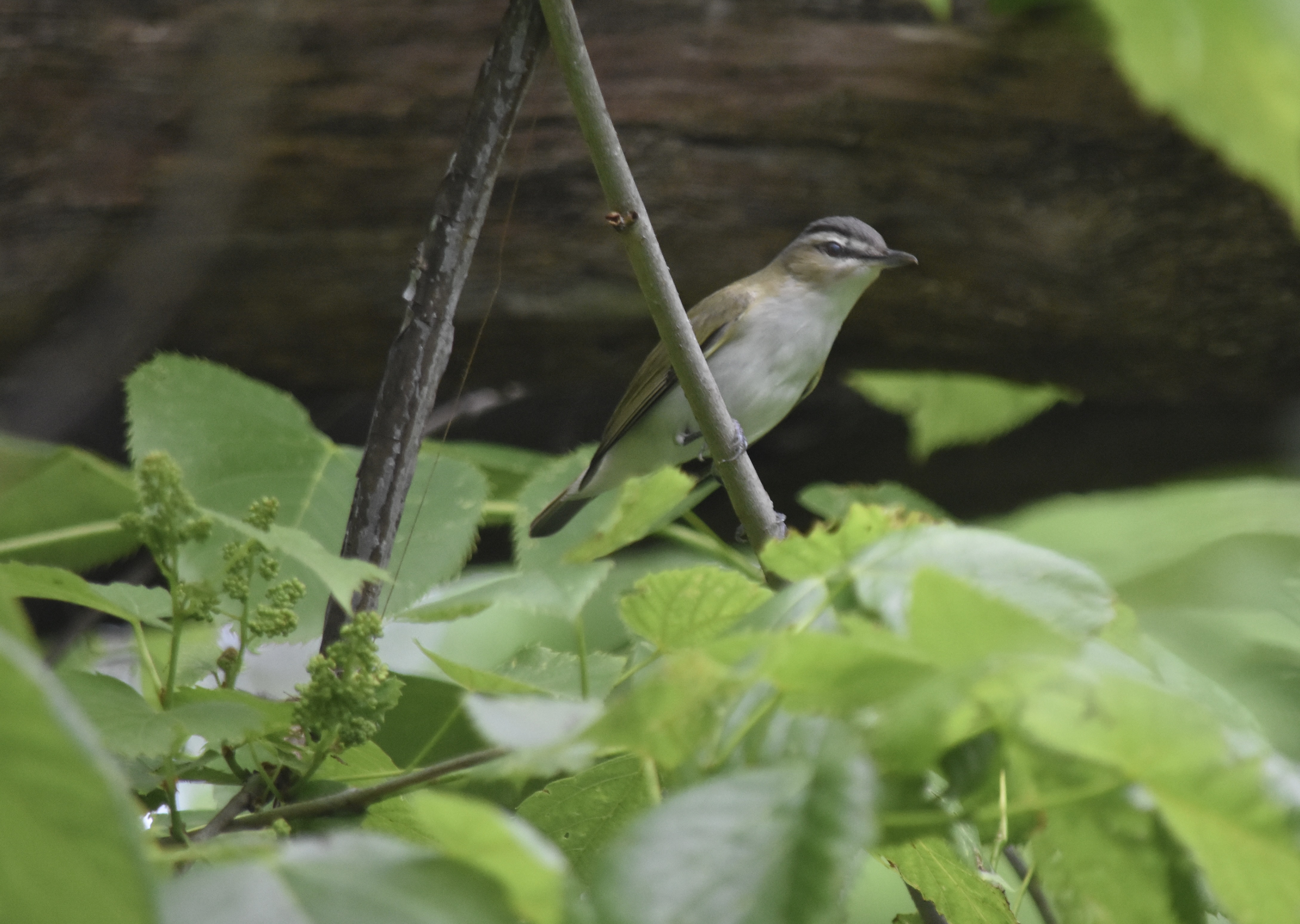
I think this one is a red-eyed vireo (and immature one that hasn't developed the red eye yet). We heard its song repeatedly, but couldn't definitively locate one.


This seems like an idyllic image to end with!

Thursday, 23 November 2023

Day 13 September 10: Petra, Part 1

So you may recall our hotel was right next to the Petra archaeological site.

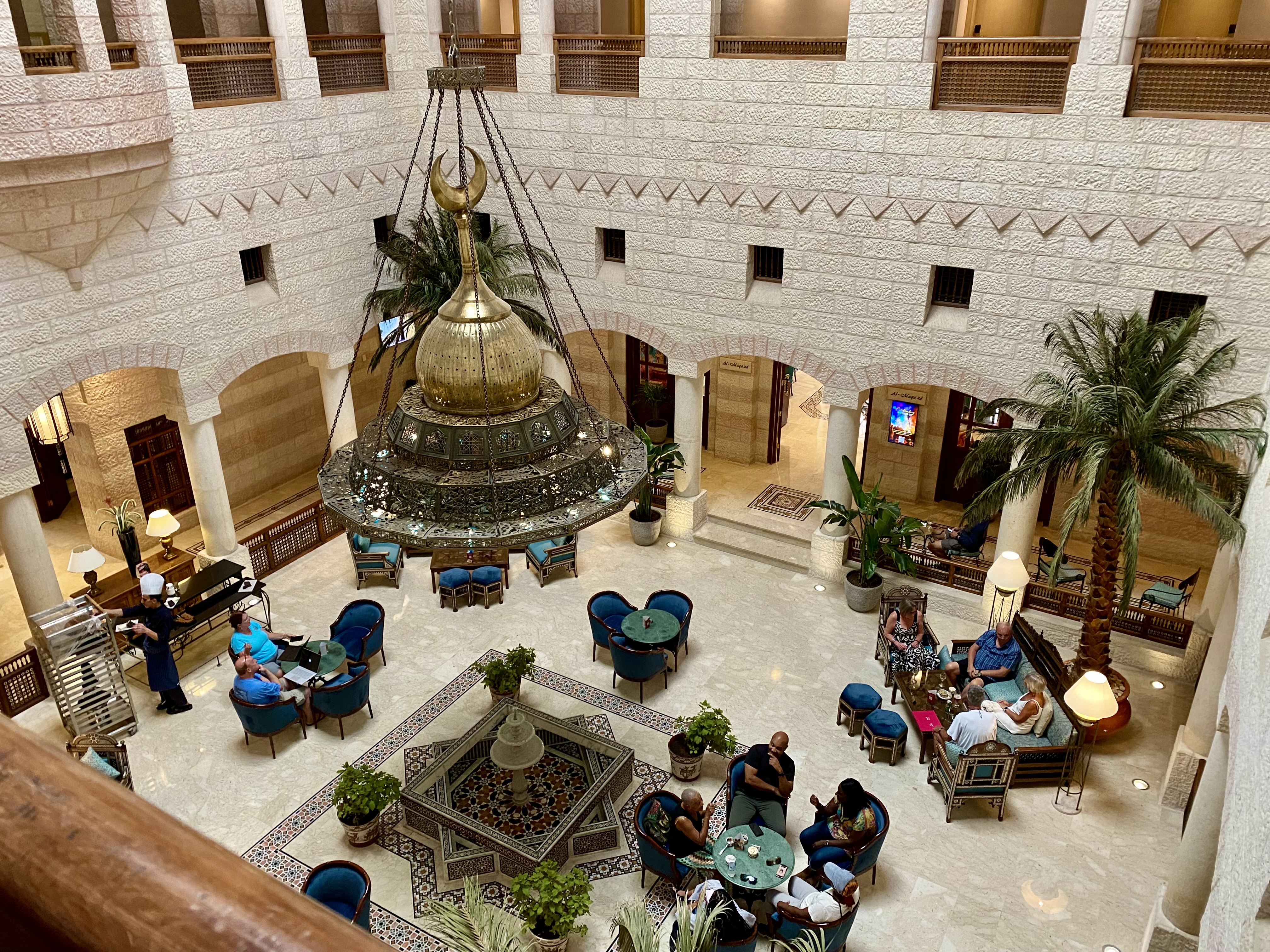
It was a lovely, elegant place with clean rooms and minimalist decor.


We had a magnificent dinner and breakfast buffet served on carts with Arab-influenced designs.


It seems like pastries were a big thing everywhere we went!

And there was this vivid pink cauliflower/pickle

Not a bad picture of yours truly riding the elevator at the hotel!

So the morning of September 10th we headed down to the lobby and over to the Petra site.


Petra is famous to many Americans from scenes shot in one of the Indiana Jones movies.


It was a huge place 102 square miles according to wikipedia.


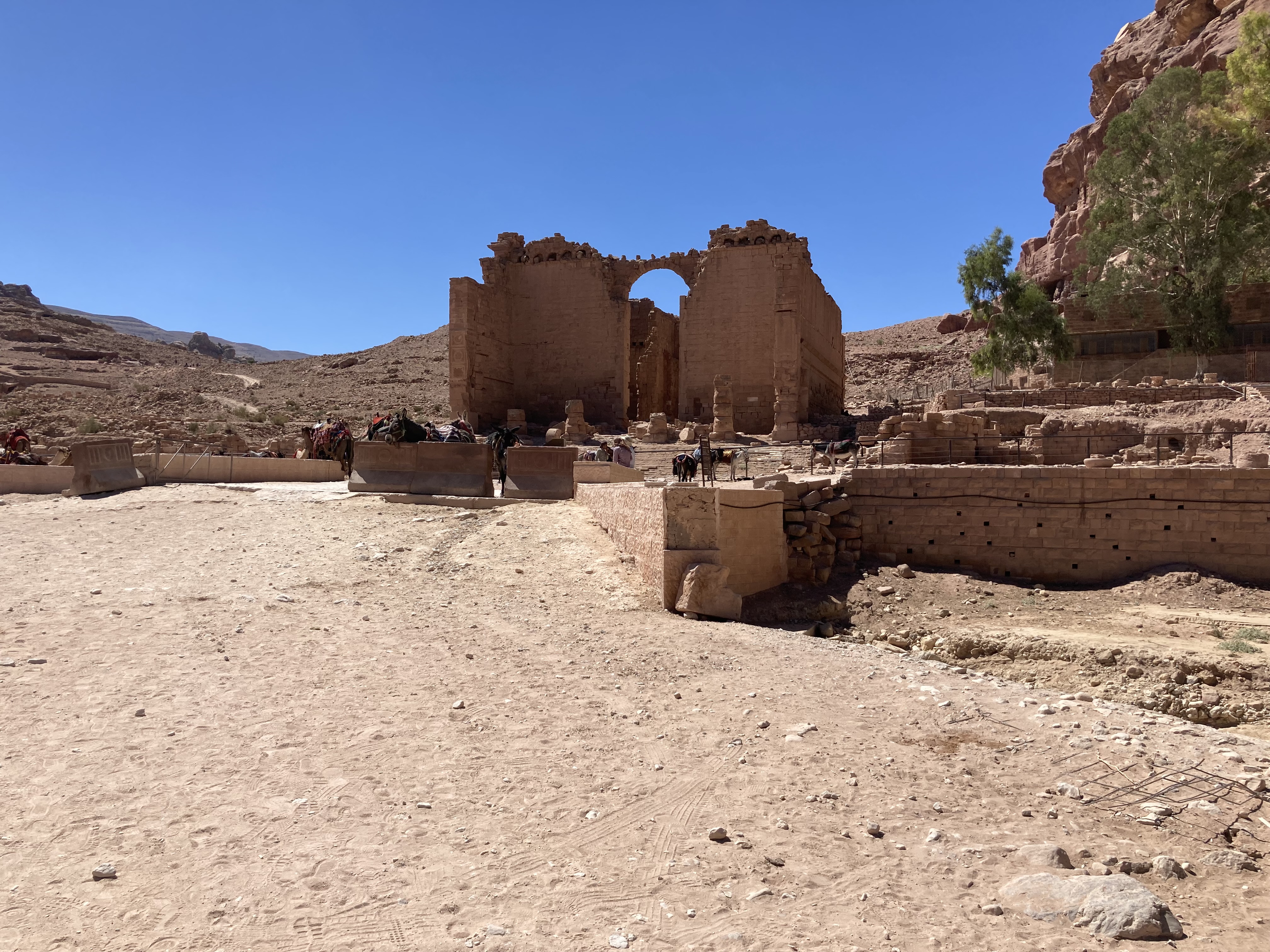
After you enter the grounds, there are a lot of horses that you pass before seeing some of the earliest caves and the Djinn blocks.


Most of these pictures are not in particular order, but the sights are truly awe-inspiring.


There are actually different kinds of terrain in the park.


This is a fairly long walk (especially when you are heading back to the hotel!) ;-)


The first area one encounters is an area with large blocks of stone.


These Djinn blocks were tombs about 400 meters after the entrance to the park.


There are about 26 of them. The Bedouins say that ghosts or djinn lived in them.


People lived in many of these caves until the area was made into a park.


On the south we also saw the so-called Obelisk tomb and triclinium. The pointy structures on the top of the tomb are not obelisks, but nefeshes (a pillar like stone used as a kind of grave marker). Beneath the Obelisk tomb is the Triclinum Bab as-siq. (Door of the Siq). A triclinium is a kind of dining hall with three benches (the trim in triclinium) used to honor the dead.


After passing the Djinn blocks, we walked through a passage with amazing rock formations. This is the Siq. Here is a Google earth Map of the path. The red dot is the Obelisk tomb.


The colors in the rocks are magnificent and change with the light.


The area was inhabited by the very early civilization, the Nabataeans (perhaps as early as 7000 BC).


Not too much is known about the Nabataeans, that settled here. They were evidently not mentioned in the Bible per se, but we were shown some evidences of their civilization as we progressed deeper into the park. 


Along this path we also could see traces of a water system (above) for transporting water into the interior of the area.


We took dozens of pictures of the Siq, because it was just so impressive in size and variety of color.


There were tombs interspersed throughout the walkway.


Here is the obligatory elephant rock vista.


This walk alone was wondrous enough without the amazing monuments to come!


This area would become their capital city in the 4th century BC.


The Nabataeans were nomadic Arabs that prospered due to the trade routes for incense. They  inhabited the East bank of the Jordan river and we have pottery from them with thin walls with floral designs. Wikipedia has these examples photographed by Bjornpa.


There are 8 different kinds of facades identified several strongly influenced by Hellenic and Roman styles. 


There are some examples of Nabataean sculpture and painting, but most of this in Petra has been effaced by the elements. Here is one figural remnant. It looks like it might have been a camel driver with a caravan of camels at one time. You can see camel feet next to a partial figure of a man and a camel belly and possibly even back shape above the feet.


The most famous edifice in Petra is the "Treasury" a large building carved into the red rocks there. As you approach it, you cannot see that something magnificent is directly ahead of you.


The path to the "Treasury," al Khazneh, (الخزنة)  is through a passage and then you get to the opening and there it is: a large kind of plaza amidst the cliffs. Although many of the structures at Petra stem from the 1st century BC, this one seems to be an elaborate tomb cut during the rule of Aretas IV Philopatris in the 1st century CE (early in the century - like 2-40 CE) . His daughter was married to Herod the Tetrarch (yes, I think this was THE King Herod in the New Testament - there were a heckuva lot of Herods at that time!) Herod Antipas wanted to marry his brother (Herod II, of course)'s wife (Herodias, what else!) You might remember that John the Baptist's opposition to this marriage lost him his head.

So... there it was!


You come out of the Siq passage and the huge tomb is right in front of you!


The Bedouins supposedly named the building "the Treasury". Perhaps this was based on an urn carved into the sandstone.


Anyway this monument is likely a tomb cut into the red sandstone cliffs for Aretas IV "King of the Nabataeans, Friend of his people" as his title insists.


In front of the building there are lots of people with camels for the tourists to ride. The Urn that supposedly contained the Roman treasure is that central cylinder above the tympanum.


The urn is completely solid and could not ever have contained anything. Nonetheless there are many bullet holes testing whether the treasure might not be accessible if the urn were to be opened somehow. If you click on the image you might be able to discern some of them.


One legend says that the Egyptian pharaoh created the place magically when he was chasing Moses.


Unfortunately the interior is now completely empty.


Dennis Jarvis has a better photo on Wikipedia showing the colors of the interior.


This facade was used in the Indiana Jones and the Last Crusade film (made in 1989) to signify the resting place of the Holy Grail.


There are of course lots of tourists here. (Many, I think turn around after they reach this most famous part of the park.)


We luxuriated in the beauty of the spot and then knew it was time to think about moving on.


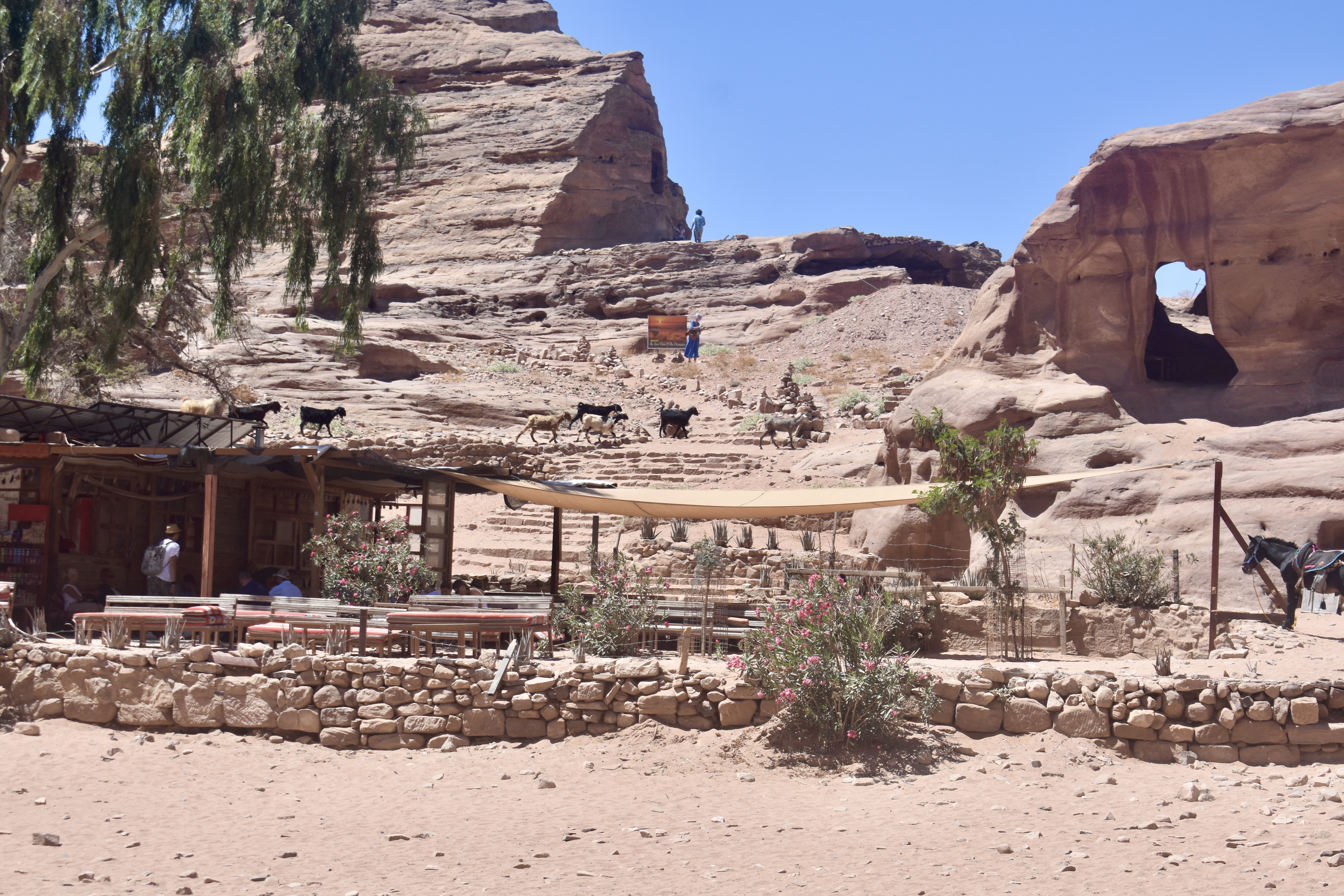
Then we headed off to our left (farther to the West) past tall cliffs on our left called "The High Place of Sacrifice."  We were tired at that point and took some time to rest at a place for refreshments.


There was a kitty there, who was very friendly.


We were fortunate to be there at pomegranate juice season and it was interesting to watch them fresh-pressing the juice.


The press looked like some kind of an exotic alien machine!


Here is our group enjoying being able to sit for a while.


We passed by the street of Facades, taking a quick glance at the so-called Unayshu (or Uneishu) tomb. This one is a Hegra-type facade. Universes.art describes it as consisting, "of a principal order (entablature, a plain attic with mouldings crowned by two large half merlons) which is supported by two pilasters with Nabataean capitals. The door, reached by three steps and flanked by two very narrow pillars supporting an entablature, is optically enlarged by a second frame of pilasters with engaged quarter columns and triangular pediment, where three acroterion bases can still be seen.

The almost square funeral chamber (7,90 by 7,60 m) has three loculi in the back wall and four loculi in each of the side walls. Another loculus can be seen on the exterior right wall carved very high."


Continuing down the road, we could look back over our right shoulders and see the impressive grouping of royal tombs.  


There are almost 900 tombs scattered about in Petra, but the massing of these large elegant ones together makes them especially imposing.


If you look at the far left side of this image above you can see the Palace tomb. Next to it is the so-called Corinthian tomb.  Right above the horses you can also see the "Silk tomb" which has beautiful, colorful striations and the Urn tomb. Here is a closer view of the Palace and Corinthian tombs from Worldalldetails.com


The road that we travelled on heading toward the theater was full of souvenir booths and stalls.


The map doesn't really give us an indication of what the tombs are in this area, but we see the same stair step ornaments and columns as on other buildings.


Then we come to the Roman-style theater (مسرح البتراء). This theater has three tiers of seating carved into the rock. There are seven stairways and seats for roughly 8500 people and is bigger than the Roman theater in Amman that we would stop at later.


The pillars are supposedly Nabataean in character rather than Roman, but there hardly seems enough of them left to tell what they originally looked like.


People wonder whether Aretas IV Philopatris might not have built this mammoth structure to try and compete with some of the giant projects of Herod the Great.


Heading farther down the road we saw this big store with frankincense and myrrh and other local kinds of souvenirs.


All along the way are lots of horses (I think people start to get tired at this point especially when on the way back.)


Of course there was a Starbucks here (although I seriously doubt it is affiliated with the famous franchise!)


Our friend Wayne went in there and we didn't see him or his wife the rest of the day! ;-) I think they arranged some kind of special private tour!


It was a cozy little place (but pretty dark inside when there was no camera flash!)


This was the place to shop, but I had other things on my mind (like whether I would have the stamina or not to make the climb to the Monastery.)


After this point we were headed to an area that had much stronger Roman influence. I'll address this and the trip to the Monastery in the next section of the blog.